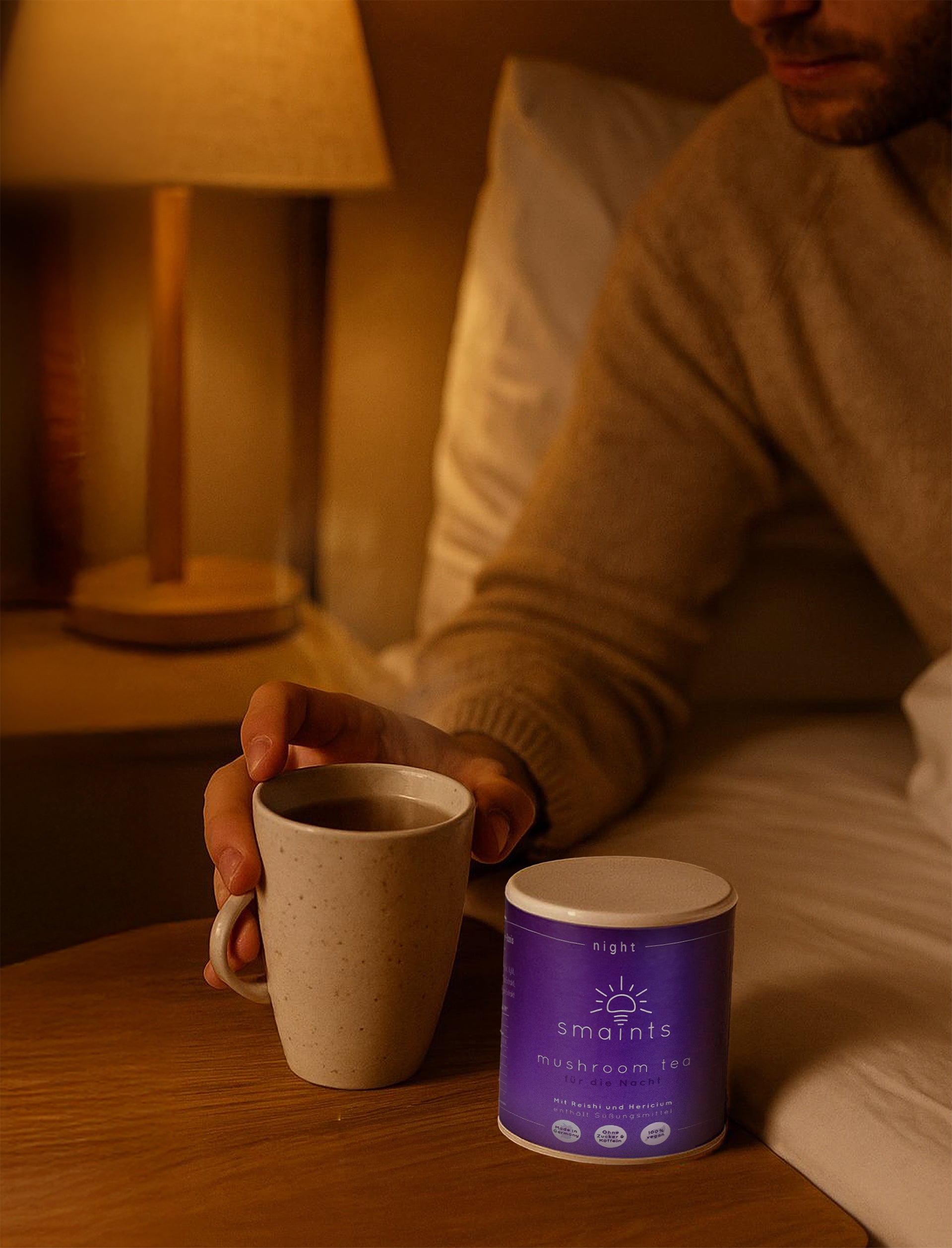

The land of dreams – that's another way to describe REM sleep. But why is it so important for your health? And how can you influence it? Learn everything you need to know about it here, including how to improve your REM sleep.
During the night, we repeatedly cycle through different sleep phases. First comes non-REM sleep (non-rapid eye movement). This phase is divided into three stages:
N1: Transition between wakefulness and sleep, sleep onset phase
N2: Short phase, waking up is somewhat more difficult, muscles relaxed
N3: Deep sleep, regeneration, cell division and more
This is followed by REM sleep. REM stands for 'rapid eye movement' and refers to short, rapid eye movements. Dreaming occurs during this time; our brain is now very active, and small eye movements occur. The muscles of the arms and legs, however, are paralyzed, meaning you can't move them. While breathing is relatively shallow during deep sleep, it becomes more active during REM sleep. Heart rate and blood pressure also increase. This phase is reached about 90 minutes after falling asleep and accounts for 20 to 25 percent of sleep in adults. Babies can even spend 50 percent of their sleep in this stage. Some people wake up after REM sleep ends, while others sleep through it before a new sleep cycle begins.
The sleep phases repeat themselves approximately every 90 to 110 minutes, except for the initial sleep onset phase. Therefore, with eight hours of sleep, you can complete the cycle five times. The duration of each stage changes throughout the night. Deep sleep dominates at the beginning, while REM sleep increases later. This means that too little sleep leads to a significantly shorter REM sleep phase.
At first glance, deep sleep and its regenerative properties seem crucial for sleep quality, but REM sleep is also important. But why is dreaming significant? And what does that have to do with your recovery and health?
While you sleep, your brain is busy tidying up. This happens during REM sleep, when the brain is most active. In fact, almost as much activity and brainwaves can be measured as when you're awake. For example, information is transferred from short-term to long-term memory. This part of sleep is therefore crucial for your memory and learning. A study on mice also investigated the formation of new brain cells in the hippocampus. This brain region can be compared to a working memory, a switching point between short-term and long-term memory. If new cells are formed here during the day, they are reactivated at night during REM sleep and essentially store the learned information. The mice in the experiment were also able to remember what they had learned the following morning. Researchers assume that the brains of mice function similarly to the human brain, and therefore the results can be extrapolated.
There is evidence that your brain is cleansed at night. A Japanese research team showed that blood flow increases in mice during REM sleep. This not only leads to an increased oxygen concentration, but also helps to remove waste products. If these substances remain in the brain, it increases the risk of developing Alzheimer's disease.
While we can dream in any sleep phase, it happens most frequently and vividly during REM sleep. This is why it's also called the dream phase. Why exactly people dream remains one of the mysteries that hasn't been fully solved. Presumably, we process the day's experiences, feelings, and impressions while dreaming. Sometimes we can remember them, and other times we can't. Why? That, too, remains unanswered.
Lucid dreaming is currently a major trend among biohackers . It means being able to actively experience and, to some extent, control your dreams. The dreamer is aware that they are asleep. This type of dreaming always occurs during REM sleep. The goals can vary. Some people use it to protect themselves from nightmares, others want to experience superpowers, and still others train their memory at night. For example, they might practice driving in their sleep before their driving test. You can learn to lucid dream through exercises and technical aids such as special sleep masks.

We only truly become aware of the importance of some bodily processes when they are disrupted. This is also true for REM sleep. A recent study linked low REM sleep to increased mortality. Physical and psychological problems also become noticeable when you lack REM sleep. Your concentration and memory can suffer. In the long term, the risk of certain diseases also increases. For example, metabolic waste products are removed during the REM phase; if this doesn't happen, the risk of Alzheimer's disease increases.
There is also REM sleep behavior disorder. In this condition, those affected move around excessively during REM sleep. They might, for example, shout loudly, hit, kick, or bite. The risk of injury to themselves and their partners is significantly increased. The causes of this sleep disorder are varied. Some medications can trigger it, and it can also be a precursor to other illnesses such as Parkinson's disease. Therefore, you should get checked out if you experience any signs of a sleep behavior disorder.
Sleep is essential for your overall health. Besides deep sleep, REM sleep is also very important. We'll show you five tips on how to get healthy sleep and even improve your REM sleep.
Generally speaking, getting enough sleep is essential for daytime energy. But it's not always that simple. Sometimes there's not enough time, and other times falling asleep just isn't easy. That's why we recommend a consistent evening routine. Go to bed and wake up at the same time every day. You'll find more helpful sleep tips in another blog post .
You're probably familiar with the sleep-promoting properties of valerian or hops. But mushrooms can also improve your sleep. Hericium is particularly interesting for REM sleep. This mushroom promotes the growth of your nerve cells. More precisely, it stimulates nerve growth factors ( NGF ) in the brain. While you dream, new connections are formed in the brain. NGF can support these processes. A study in mice showed that REM sleep deprivation leads to a lower NGF concentration in the hippocampus.
Reishi , another medicinal mushroom, has been used in traditional Chinese medicine for many years as a natural remedy for sleep disorders. Together, they are a real insider tip for your sleep.
You can improve your sleep by creating optimal conditions. These include:
Room temperature : The best temperature for sleeping is between 16 and 18 degrees Celsius. Interestingly, REM sleep increases at higher temperatures . When the body doesn't have to worry about maintaining its core temperature, REM sleep is longest. In humans, this temperature is around 23 degrees Celsius, depending on your clothing and how warm your bedding is.
Light : We naturally sleep in darkness. Light, on the other hand, wakes us up. So, reduce light sources while sleeping. This also applies to screens. Alternatively, you can use blue light filtering glasses. (Recommendation:Lichtblock.shop )
Nutrition : Avoid alcohol and particularly heavy or fatty meals right before bed, as this impairs sleep quality. A healthy diet, on the other hand, provides your body with all the essential nutrients and vitamins. This ensures all the necessary conditions for the production of neurotransmitters and other substances.
Stress, anger, anxiety, and other emotions make it difficult to fall asleep because you can't switch off. Therefore, it's helpful to practice relaxation exercises before bed. Examples include breathing exercises, relaxing music or sleep-inducing audiobooks, and autogenic training. Yoga also helps, provided it's not too strenuous, as exercise wakes you up again and is therefore best suited for the morning, midday, or early evening.
How can you actually know if your REM sleep is improving or not? That's why it makes sense to measure it. There are various ways to do this. The simplest are wristbands that use movement at night to infer your sleep phases. While this isn't always precise, it still gives you a first impression. Slightly more expensive are devices that also measure brain waves. Before you decide on a tracker, you should thoroughly research how it measures and how reliable the method is. If you have serious sleep problems, then a night in a sleep lab might be an option. Here, a lot of data about your sleep is collected to subsequently analyze what you're lacking.
Still have questions? We've compiled the most frequently asked questions and their answers for you:
Approximately 90 to 110 minutes per night
It varies greatly from person to person. Most people get by well with seven to eight hours a day. Others need up to ten hours, and still others are perfectly fine with just five hours.
By inferring movements, heart rate, blood pressure at night, and brain waves.
If you wake up during a specific REM sleep phase, you may find yourself unable to move for a short time. This is perfectly normal and is called sleep paralysis. If this is accompanied by significant anxiety, you may need to seek medical advice. It could also be a sign of a sleep disorder.
No, you can dream even during deep sleep or other sleep phases, but the most intense dreams occur during REM sleep. These are also the dreams you are most likely to remember.
Yes, babies have a high proportion of REM sleep. In adults, the duration of REM sleep remains stable for a long time, between 20 and 25 percent of total sleep. From around age 60, REM sleep then decreases.
Sources:
https://www.aok.de/pk/magazin/wohlbefinden/schlaf/was-ist-rem-schlaf/
https://www.cell.com/neuron/fulltext/S0896-6273(20)30354-8
https://www.sciencedirect.com/science/article/pii/S221112472100992X?via%3Dihub
https://jamanetwork.com/journals/jamaneurology/fullarticle/2767713
https://www.tandfonline.com/doi/full/10.1080/21501201003735556?cookieSet=1
https://www.sciencedirect.com/science/article/abs/pii/S0006899300027086?via%3Dihub
https://www.psych.mpg.de/848223/schlaf


Organic functional mushrooms
from Europe

Scientifically developed - tradition meets modernity

Suitable for everyday use & delicious

Independently laboratory tested
in Germany