Are you familiar with the Finnish medicinal mushroom Chaga? Its active ingredients are being scientifically studied in many places. We've taken a closer look at the studies and summarized the current state of research. Learn everything about the effects and uses of the Chaga mushroom here.
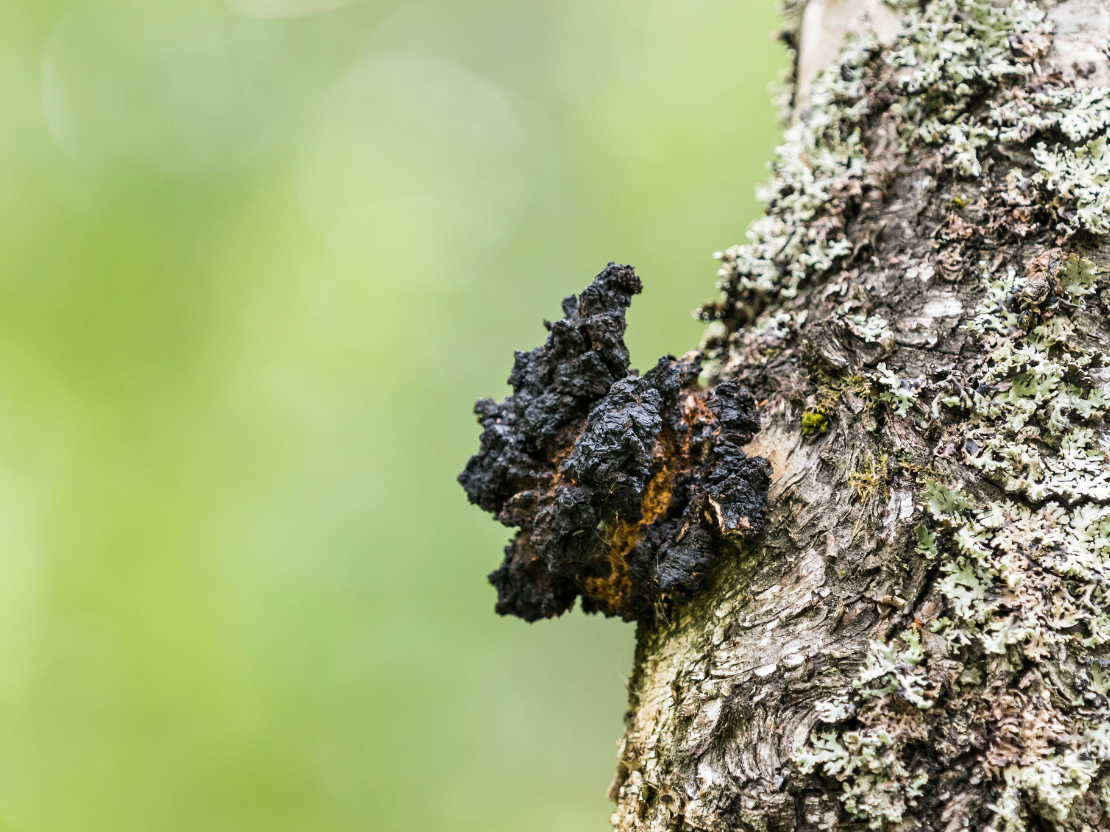
Chaga is a medicinal mushroom primarily known from colder regions such as Finland, Lapland, Russia, and Ukraine. There, it has been used as a home remedy for boosting the immune system since around the 12th century. Today, chaga mushrooms are highly regarded worldwide. The mushroom typically grows on birch trees and can be harvested after at least five years. Chaga mushrooms also grow in northern Germany, but no efficacy has yet been demonstrated with locally grown varieties. Therefore, mushroom extracts, powders, or teas used as medicinal mushrooms usually originate from Finland or Russia. Occasionally, you may also find chaga under the names Inonotus obliquus or birch polypore.
Incidentally, the birch tree is attributed with positive properties in naturopathy. For example, a tea made from its leaves is said to help with urinary tract infections or rheumatism. The Germanic tribes used birch sap as a beauty and tonic. The chaga mushroom grows into the birch bark and can thus draw nutrients and sap from the tree.

Chaga mushrooms are rich in various nutrients, containing over 200 substances. Notable among these are their vitamin B content, several minerals such as potassium, iron, calcium, magnesium, and zinc, as well as secondary plant compounds like polyphenols, betulinic acid, and polysaccharides (sugar compounds). Some of these substances are believed to have health-promoting effects. In general, the mushrooms are said to have strong antioxidant and anti-inflammatory properties. We have taken a closer look at the scientific studies on chaga and summarized the results for you.
Our immune system is crucial for overall health, as it protects our body from pathogens. We can influence and strengthen our immune system through certain nutrients in our diet. Well-known examples include zinc and vitamin C. Chaga is also said to support the immune system. Scientists have conducted experiments on cell cultures and have reached the following conclusions:
So far, there are relatively few studies on fungi that go beyond cell culture experiments. For example, one experiment with fish showed that feeding them chaga increased their resistance to pathogens. This is an important finding for fish farming! However, it is not entirely clear whether these findings from cell lines and a few animal experiments can be directly applied to humans.
In our search for scientific articles on the effects of chaga, we also came across a publication on its use in humans. The study examined people suffering from both gastrointestinal disorders and psoriasis. Psoriasis is a skin condition in which the immune system malfunctions. Treatment with chaga proved to be very beneficial in this case.
All current findings on Chaga and the body's own defense system indicate a very high potential for the mushroom, which will be further explored through more meaningful studies.
Another cell study showed that a water extract of the chaga mushroom inhibits the growth of hepatomas. Hepatomas are tumors in the liver. Whether the chaga mushroom can generally protect the liver cannot be said with 100% certainty with current knowledge. The study only provides indications of some potential benefits.
Traditionally, the chaga mushroom is used to treat gastrointestinal ailments, particularly gastritis and stomach ulcers. We found no scientific evidence to support this potential therapeutic effect. However, one study did demonstrate changes in the gut flora of mice following the administration of this medicinal mushroom. Polysaccharides, in general, are prebiotics that provide nutrients to gut bacteria and can thus modulate their balance. These beneficial sugar compounds are also found in chaga mushrooms. They could be responsible for the healthy bacterial profile observed after chaga administration. Further studies are needed to confirm these anecdotal findings.
Stabilizing blood sugar levels is highly desirable in diabetes. Some superfoods are said to have precisely this effect, and chaga is one such example. In a study using specific polysaccharides from the chaga mushroom, fasting blood sugar and plasma insulin levels were significantly reduced in diabetic mice after four weeks of treatment. In another study, the tissue of the pancreas in diabetic mice was examined after treatment with chaga. The existing damage was able to regenerate. The pancreas produces the necessary insulin to lower blood sugar.
Here too, the findings so far have only been studied in animals. It is impossible to say whether this can be applied to humans.
In several studies on mice, treatment with polysaccharides from chaga mushrooms improved endurance and reduced early fatigue. The mice were able to swim for longer periods. Furthermore, glycogen levels in the liver and muscles increased. Glycogen can be considered readily available energy. Thus, chaga mushrooms were able to delay physical fatigue. The extract also had an effect on the mice's mental performance.

This question cannot yet be answered. Some studies on cell cultures have observed an inhibitory effect on the growth of cancer cells. Anti-cancer activity of the immune system has also been demonstrated. However, there are no studies that prove these effects in humans. Therefore, for the treatment of cancer, the focus should not be on chaga mushrooms, but rather on medications with demonstrable benefits. Only if the chaga mushroom proves effective in new studies can this assessment be reconsidered.
Since there are hardly any scientific studies on humans regarding its effects, side effects are also poorly understood. Animal studies showed no toxic effects from chaga treatment. However, because the mushroom has been used in traditional naturopathy for a very long time, anecdotal evidence can be consulted. It is known that the medicinal mushroom contains oxalic acid. If ingested in large quantities, this can accumulate in the kidneys and lead to kidney stones. However, chaga is not the only food containing oxalic acid. It is also found in spinach, rhubarb, and beetroot. Therefore, you should not exceed the recommended daily dose of chaga supplements. However, daily doses of 500 mg of chaga extract or when brewing chaga tea are considered safe.
Caution is advised when taking blood thinners concurrently. Chaga is suspected of having blood-thinning properties and therefore increasing the risk of bleeding.
Chaga mushrooms (Inonotus obliquus) can be used to supplement a healthy diet. You can find this medicinal mushroom in various forms on the market. It is offered as chaga tea, as a tincture for external use, and in the form of capsules, powders, or extracts. In addition, there is a growing number of innovative dietary supplements available, such as coffee substitutes made from medicinal mushrooms or our Golden Mushroom Milk from smaints.

To brew chaga tea, you'll need dried pieces of the mushroom. Boil about twelve grams in one liter of water. Simmer the chaga tea for about ten minutes over low heat. Then strain it through a sieve. About two cups a day are generally well-tolerated. Many people drink chaga tea in the evening, hoping it will help them sleep better.

Preparing it as a drink is even easier with our Golden Mushroom Milk . Simply stir a slightly heaped scoop into 200 ml of warm milk or a vegan alternative. Up to two cups a day are recommended. In addition to chaga mushrooms, it contains other beneficial ingredients such as shiitake , turmeric, acerola, and black pepper, which can provide lasting support for your immune system.
Using Chaga mushroom with smaints' Pure Immune liquid extract is just as straightforward. You can take a teaspoonful daily, either straight or mixed into a drink or food. This extract also contains almond mushroom (ABM) for an optimal combination of medicinal mushrooms. Thanks to an innovative and gentle dual extraction process, you receive the maximum spectrum of active ingredients from the Chaga. It is also more bioavailable than traditional powders. Our products are lab-tested and manufactured in Germany, ensuring you receive top-quality results.
Incidentally, our Chaga extracts from both products come from Finland - the optimal vegetation zone for potent and active ingredient-rich Chaga mushrooms.
The chaga mushroom (Inonotus obliquus) is a medicinal mushroom native to colder climates like Finland. It prefers to grow on birch trees and can absorb the valuable nutrients from the birch sap. Chaga has long been valued in naturopathy because it contains many nutrients such as vitamins, minerals, polysaccharides, and phytochemicals. It is said to strengthen the immune system, act as an antioxidant, and inhibit inflammation. The mushroom is also believed to have a positive effect on the liver, the gastrointestinal tract, blood sugar levels, and stamina. There is some initial scientific evidence to support these claims, but they are not yet 100% proven. We advise against using chaga for cancer treatment, as there is currently a lack of conclusive human studies on its use in this area.
Those wishing to buy chaga mushrooms have a choice between chaga tea, chaga mushroom extract, other dietary supplements, and fortified foods. When using these products, you should always follow the retailer's instructions, as consuming too much chaga mushrooms can lead to kidney stones. However, you don't need to worry about 500 mg per day.
We at smaints are convinced of the quality of our Chaga products. Both our liquid extract and Golden Mushroom Milk are easy to use, effectively combined, and of lab-tested quality. Our Chaga mushrooms are wild-harvested in Finland. You can find more information about the products and all their benefits here:

Sources:
https://pubmed.ncbi.nlm.nih.gov/27865960/
https://pubmed.ncbi.nlm.nih.gov/23510282/
https://pubmed.ncbi.nlm.nih.gov/22462058/
https://pubmed.ncbi.nlm.nih.gov/22484608/
https://pubmed.ncbi.nlm.nih.gov/18203281/
https://pubmed.ncbi.nlm.nih.gov/28197985/
https://www.sciencedirect.com/science/article/abs/pii/S0278691517300078?via%3Dihub
https://www.sciencedirect.com/science/article/abs/pii/S0378874108001086?via%3Dihub
https://pubmed.ncbi.nlm.nih.gov/32068062/
https://pubmed.ncbi.nlm.nih.gov/26427119/
https://pubmed.ncbi.nlm.nih.gov/19041933/
https://pubmed.ncbi.nlm.nih.gov/21191814/
https://www.mskcc.org/cancer-care/integrative-medicine/herbs/chaga-mushroom
https://examine.com/supplements/chaga/
https://www.medizin-transparent.at/chaga-pilz/

49,99 €

Pure, highly concentrated, and bioavailable mushroom extract
Organic dual-extracted functional mushroom extracts from EU organic cultivation – independently lab-tested and certified in Germany
90 capsules per glass for up to 90 days - only 1 capsule per day necessary
Min. 10% beta-glucan content - independently laboratory tested & results published
100% free from fillers, anti-caking agents, microcrystalline cellulose, carrageenan, and PEG – in vegan HPMC capsules
Beantworte 6 kurze Fragen zu deinen Zielen und deinem Alltag.


Organic functional mushrooms
from Europe

Scientifically developed - tradition meets modernity

Suitable for everyday use & delicious

Independently laboratory tested
in Germany