
Naturally leading to better sleep, more serenity, and well-being. Does that sound exactly like what you're looking for? Then it's time to learn more about the effects of Ashwagandha, an Indian medicinal plant. We'll show you how to use it, what to consider when buying it, and the effects of Ashwagandha.
The word Ashwagandha comes from the ancient Indian language Sanskrit and roughly translates to 'smell of the horse'. You'll also find this medicinal plant under the names sleep berry, winter cherry, Indian ginseng, and Withania somnifera. It likely originated in Africa. Today, however, the plant is widespread from the Canary Islands across Africa, Spain, Italy, Greece, Western and Southern Asia, and as far as China. Botanically, it belongs to the nightshade family. The plant's berries are deceptively similar to physalis (Cape gooseberry). However, the bright red fruits are not of particular interest for herbal medicine; rather, it is the root and leaves that are used.
Ashwagandha is now known worldwide as an adaptogen. However, its beneficial effects were discovered thousands of years ago by Indian healers. In Ayurvedic medicine, ashwagandha is one of the most important medicinal plants. It is also an integral part of natural medicine in other cultures. In Nepal, Sri Lanka, and parts of Africa, people use ashwagandha.

Unlike modern medications, medicinal plants are not only recommended and taken for specific illnesses. Ashwagandha, for example, has a wide range of applications. Its best-known effect is to promote sleep (hence its name "sleep berry"), but the plant is expected to do much more:
generally a balancing effect
Support for anxiety
Relief from menopausal symptoms
positive influence on the nervous system
anti-inflammatory
tonic for insomnia
Fountain of youth against the ailments of old age
pain-relieving
aphrodisiac effect
The effects of ashwagandha in naturopathy are known from tradition and anecdotal evidence. Not all of them stand up to scientific scrutiny. Others, however, do. Therefore, we'll examine the current state of research for you.
Scientific studies on the effects of substances generally involve three different stages of research. First, the active ingredients are tested on cells in petri dishes. Next, the effects are analyzed in laboratory animals, and only then is an extract tested on humans. Occasionally, a step can be skipped if the safety of the medicinal plant is already known. In principle, studies with humans provide the most information, but they are also the most difficult to conduct because they are prone to errors. For example, it is not possible to completely standardize the rest of the lifestyle. This is possible with animal experiments. Their significance is higher compared to cell experiments. However, their results cannot always be extrapolated to the human body. Cell experiments are the simplest and cheapest, but their significance is limited. They provide a good basis for further research.
Most research on ashwagandha is based on cell and animal studies. While some human studies have been published, they do not always meet scientific standards. There are only a few well-conducted human studies.
Researchers in Japan administered alcoholic and aqueous solutions of ashwagandha to laboratory mice. They found that only the aqueous extract had a sleep-inducing effect. They then isolated the active ingredient triethylene glycol from the plant and administered it to the mice. The result: The mice fell asleep faster and had a longer period of deep sleep. However, the REM sleep phase remained unchanged.
Another research group compiled and analyzed the results of several human studies. They concluded that ashwagandha (Sleep Berry) slightly increased the overall duration of sleep. Furthermore, the study participants felt more alert after sleeping, and their anxiety also improved.

Stress is a daily companion for many. However, in the long run, it can be an emotional burden, lead to reduced performance, and even cause illness. Stress can be measured by cortisol levels. In studies, this lab value, along with questionnaires, is frequently used to assess stress levels. This was also the case in an Indian study . People suffering from chronic stress were divided into an ashwagandha group or a placebo group. The first group received a highly concentrated extract of ashwagandha root (300 mg twice daily) for 60 days, while the other group received a placebo. A subsequent comparison of the two groups showed a reduced stress level in the ashwagandha group. The researchers concluded that the extract increases stress resilience and improves quality of life.
In another study with an ashwagandha and a placebo group, researchers examined participants over eight weeks. All participants were healthy, athletic men. In the first group, participants received ashwagandha root extract. The researchers were interested in endurance, specifically measuring VO2max. This value indicates how much oxygen from the air reaches the muscles. With increasing endurance, this value also increases. Additionally, antioxidant levels were measured, and questionnaires were used to assess stress levels and quality of life. All results for the ashwagandha group were better than those for the control group.
Due to the small number of participants observed, the study cannot yet prove an improvement in endurance through ashwagandha, but it is a valuable first indication.

In a study , people with mild cognitive impairment received an extract from the ashwagandha root twice daily for eight weeks. Before and after the treatment, researchers administered tests to assess their immediate and general memory. Compared to a placebo group, their memory improved. For example, they were better able to remember faces. Their information processing speed and attention span also increased.
It is not yet clear to what extent ashwagandha powder or capsules are beneficial for people with normal cognitive abilities and facilitate learning. However, there are studies that suggest potential benefits in neurodegenerative diseases. Thus, ashwagandha could potentially be part of the treatment for Alzheimer's and dementia in the future. However, further high-quality research is needed.
Furthermore, there are potential effects that are significantly less well-researched. The studies have not progressed beyond initial cell or animal experiments. These include, for example, its influence on cancer, the reduction of blood lipid levels, or an improvement in diabetes. These areas will undoubtedly be researched further over time. Therefore, it is always worthwhile to review current studies. However, it will certainly be several years before Ashwagandha is used in Western medicine to treat such conditions.
One reason why ashwagandha is currently enjoying renewed popularity is the trend towards adaptogens. In the biohacking scene, they are a must-have for optimizing the body. But let's start from the beginning. Adaptogens are medicinal plants or fungi that:
have a non-specific activity
regulating effect
and which are harmless, meaning they do not disrupt the normal functions of the body.
The effects of adaptogens are often attributed to the secondary plant compounds they contain, which interact with the hypothalamic-pituitary-adrenal (HPA) axis. This is a hormonal regulatory circuit that, among other things, controls the stress response. By influencing this circuit, adaptogens are intended to help you become more resilient to stress. They also affect your well-being, providing more energy and lifting your spirits when you're feeling down. Unlike medications, adaptogens are not intended to cure, but rather to provide support.
Ashwagandha is an adaptogen because it meets the required conditions. Other popular adaptogens include ginseng, maitake, rhodiola rosea, reishi, and tulsi.
Learn more about the adaptogenic effects of medicinal mushrooms.
Ashwagandha is such a popular adaptogen right now because its effects complement each other perfectly and blend seamlessly. Poor sleep leads to increased stress, difficulty concentrating, and low energy. Stress, in turn, causes sleep problems. Ashwagandha extract is said to break this vicious cycle, and in several ways. For example, if ashwagandha powder helps you sleep better, you'll also find it easier to concentrate. You'll be less stressed and therefore perceive many things much more positively. Overall, you'll be more energized during the day and more relaxed at night.

Ashwagandha is generally well tolerated, but there are occasional exceptions, especially at high doses. The results of an animal toxicity study suggest that 2000 mg of ashwagandha per kilogram of body weight daily for four weeks is likely to be free of side effects. Other guidelines suggest 300 to 500 mg of ashwagandha extract per day. However, many of the studies presented also reported that 600 mg of ashwagandha, divided into two doses, was well tolerated by the participants. Other studies have occasionally reported digestive issues when high doses of ashwagandha were taken.
Pregnant and breastfeeding women are advised against taking this medication as a precaution, since there is no data regarding side effects for these groups. You should also consult your doctor before taking it if you have autoimmune or thyroid diseases, are undergoing surgery, or have diabetes.
Side effects can arise not only from the ashwagandha itself, but also from pesticides used, improper processing, or additives. You can avoid this risk by choosing high-quality products.
Taking ashwagandha is popular, but before you use it, you should know a few things:
Ashwagandha has a rather unpleasant taste.
Do not exceed the recommended dosage to avoid side effects.
Ashwagandha is not a medicine and should therefore not replace medicines.
Ashwagandha powder is available, which is finely ground dried roots. For easier intake, the powder can also be packaged in capsules. Ashwagandha extract, on the other hand, is highly concentrated. Extract can also be sold as ashwagandha capsules or powder. We recommend the extract.
Occasionally, the content of Withaferin A is listed instead of the amount of Ashwagandha. Withaferin A is a specific secondary plant compound found in this medicinal plant.
Studies suggest a positive effect of Ashwagandha, but so far they cannot definitively prove it.
The areas of application come from Ayurvedic medicine and are based on anecdotal evidence.
Ashwagandha does not work immediately. An effect usually occurs after a few weeks.
Focus on quality, no additives, and manufacturers you can trust.
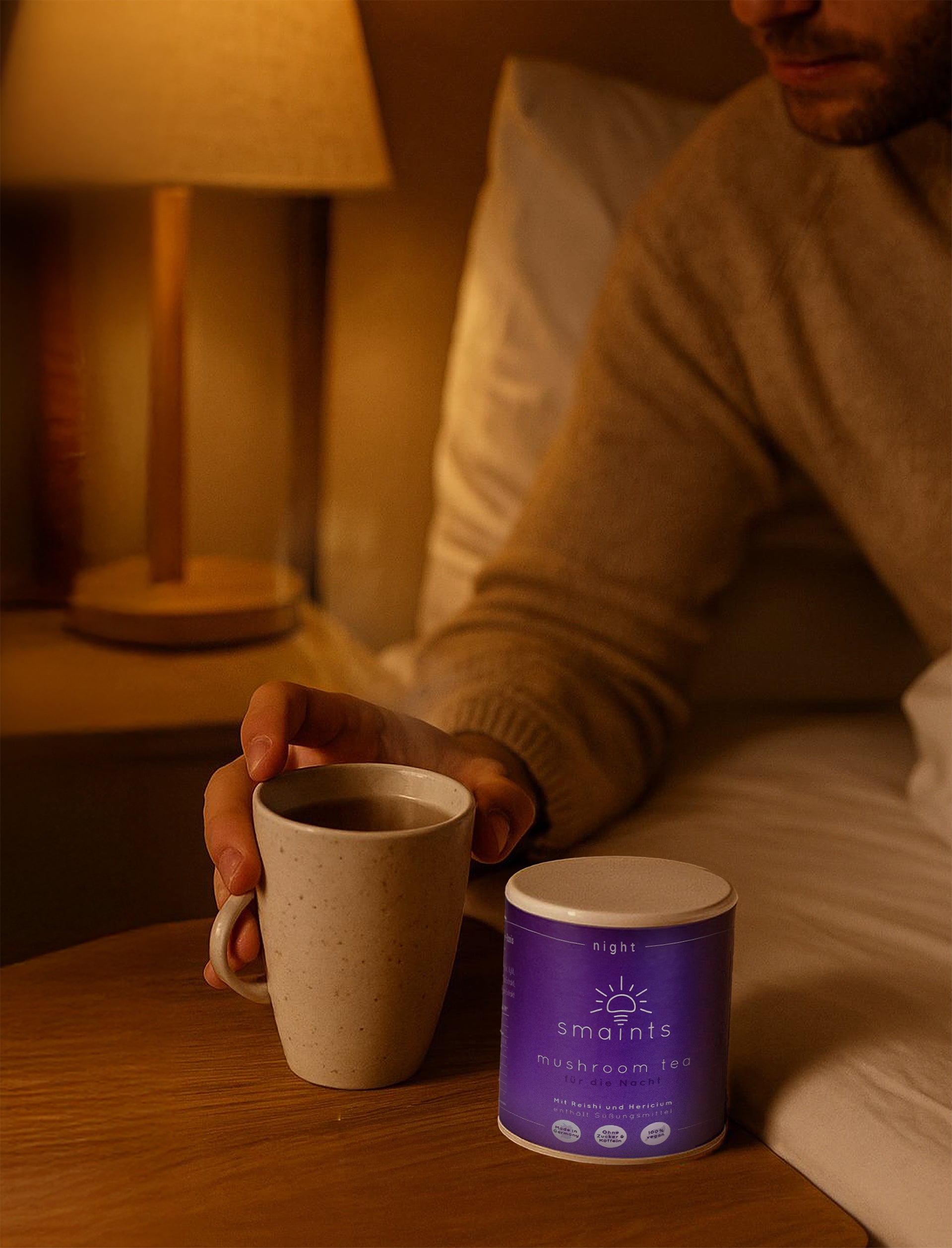
You'll find high-quality and safe ashwagandha extract in our Nighttime Mushroom Tea . We at smaints have combined the beneficial effects of various medicinal plants like ashwagandha, lavender, and valerian with the vital mushrooms reishi and hericium. The result is a delicious powdered drink that you can use as a tea to support sleep and regeneration. The base is blueberry powder, which masks the slightly bitter taste of the ashwagandha. Incidentally, the tea doesn't taste like mushrooms at all, but rather pleasantly fruity.
We recommend incorporating this tea into your daily evening routine. Routines can make it easier to fall asleep. Learn more here: Tips for better sleep .
Ashwagandha (Withania somnifera) has been used as a medicinal plant in Ayurveda for millennia. Its use remains very popular today. Ayurvedic medicine describes it as follows:
a calming effect,
an anti-inflammatory effect,
a sleep-promoting effect,
a balancing effect
and pain-relieving properties.
Researchers worldwide have studied the plant. Current findings suggest many positive effects, but cannot yet definitively prove them. For example, several scientific teams have discovered that ashwagandha increases sleep duration. Scientists have also found effects on stress levels, athletic endurance, and cognitive abilities.
The effects complement each other perfectly. Improved sleep often leads to less stress, more energy, and increased well-being. Because of these regulatory properties, ashwagandha is also considered an adaptogen, which is currently very popular.
If you are pregnant or breastfeeding, or have autoimmune or thyroid disorders, you should consult a doctor before taking ashwagandha or refrain from doing so. Otherwise, ashwagandha is generally very well tolerated, provided you do not exceed the recommended dosage.
You can find a high-quality dietary supplement with ashwagandha extract, medicinal mushrooms, and other adaptogens in our shop . We've combined the sleep-promoting effects of several medicinal plants and mushrooms in a delicious mushroom tea (drink powder) for a restful night's sleep.
Sources:
https://pubmed.ncbi.nlm.nih.gov/23439798/
https://www.sciencedirect.com/science/article/pii/S0975947616300146?via%3Dihub
https://www.ncbi.nlm.nih.gov/pmc/articles/PMC8462692/
https://pubmed.ncbi.nlm.nih.gov/28207892/
https://www.ncbi.nlm.nih.gov/pmc/articles/PMC3252722/
https://pubmed.ncbi.nlm.nih.gov/33600918/
https://pubmed.ncbi.nlm.nih.gov/32240781/


Organic functional mushrooms
from Europe

Scientifically developed - tradition meets modernity

Suitable for everyday use & delicious

Independently laboratory tested
in Germany